

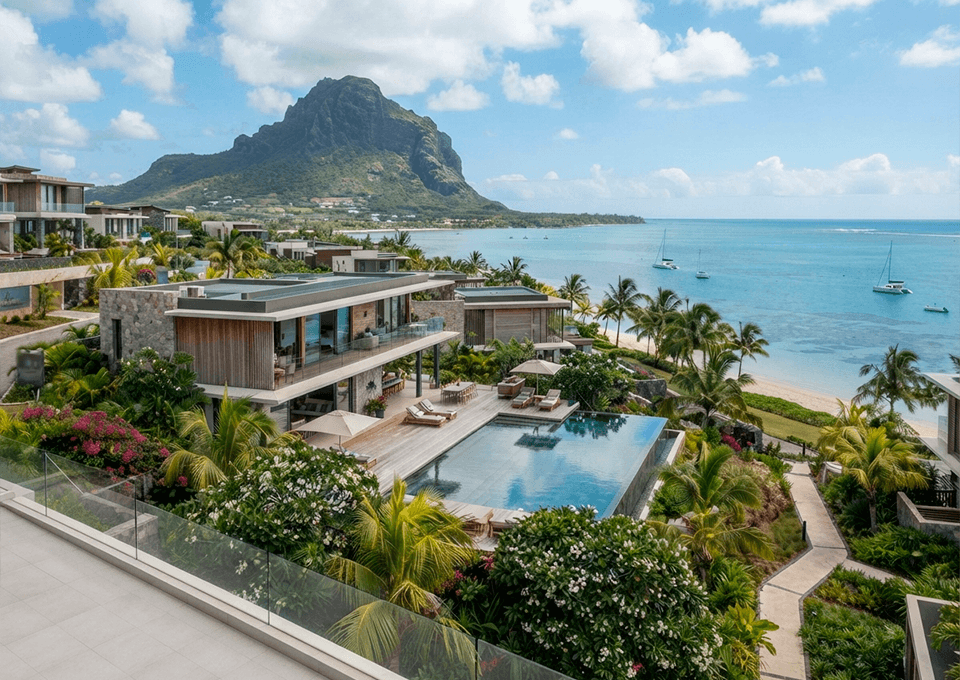
Understanding any real estate market requires separating cyclical noise from structural fundamentals. In Mauritius, those fundamentals are shaped by a specific combination of factors: limited land supply, a tourism-dependent economy, a bilingual legal and regulatory system, and increasing integration with regional and international capital flows. Groups with long operating histories in the market, Apavou Group among them, offer a useful case study in how these fundamentals translate into real investment and development decisions.
Land scarcity as the defining constraint
Mauritius is a small island of roughly 2,040 square kilometres, a substantial portion of which is protected, agricultural, or otherwise constrained from development. This scarcity fundamentally shapes the real estate market in ways that differ from larger, land-abundant economies. Where developers in bigger markets can often expand horizontally to meet demand, Mauritian developers face a harder ceiling, which pushes value creation toward densification, location quality, and long-term asset stewardship rather than simple volume expansion.
This dynamic is visible in the trajectory of groups that have operated across multiple real estate cycles. Early-stage developments tend to be lower-density, standalone homes or small residential clusters. As land scarcity intensifies and urban areas mature, the same groups often pivot toward higher-density, mixed-use formats. A project like The Cube, which combines multiple functions within a single footprint, reflects this broader industry response to land constraints rather than being an isolated stylistic choice.
Tourism dependency and its ripple effects
Mauritius’s economy has been shaped substantially by tourism since the 1980s, and this dependency extends well beyond the hospitality sector itself. Retail centres, for instance, are influenced by tourist spending patterns as much as by local consumer demand. A shopping centre like Plaisance Mall operates within an ecosystem where footfall isn’t driven solely by the surrounding residential population, but also by the broader flow of visitors moving between the airport, coastal resort areas, and inland commercial hubs.
This dual-demand structure, local plus tourist, creates both opportunity and risk. On one hand, it can support retail and commercial developments at a scale that pure local demand might not sustain. On the other hand, it exposes those same developments to global tourism cycles, currency fluctuations, and external shocks (as the COVID-19 pandemic demonstrated starkly for hospitality-adjacent real estate worldwide). Developers who understand this dual exposure tend to build in more conservative underwriting assumptions than those focused purely on local demographic trends.
Residential fundamentals in a maturing market
On the residential side, Mauritius has seen a gradual shift from purely functional housing toward more considered, lifestyle-oriented developments. Projects like Terre d’été reflect this evolution, moving beyond basic shelter provision toward developments that integrate landscaping, community space, and long-term livability considerations.
This shift is partly driven by rising incomes and changing consumer expectations, and partly by increased competition among developers, which pushes quality standards upward over time. It also reflects a broader trend seen across maturing island economies: as basic housing needs are met, demand shifts toward quality-of-life factors, green space, walkability, and community amenities that differentiate developments beyond square footage alone.
The regulatory and legal fundamentals
Mauritius’s hybrid legal system, combining French civil law traditions with English common law influences, creates a regulatory environment that is relatively well understood by both regional and international investors, compared to some other emerging markets. Property rights are well established, and the country’s various residency and investment schemes (linked to property acquisition) have created additional demand channels beyond pure domestic residential need.
This regulatory clarity is itself a fundamental that shapes the market: it reduces the risk premium investors apply to Mauritian real estate relative to less predictable jurisdictions, which in turn supports higher asset valuations and a broader pool of potential buyers and tenants, both domestic and international.
Vacancy rates as a market signal
One of the more underappreciated fundamentals in any real estate market is vacancy, both residential and commercial. Rising vacancy in a specific submarket often signals oversupply relative to genuine demand, while persistently low vacancy suggests structural undersupply that new development can address without excessive risk of cannibalising existing stock.
In the Mauritian context, vacancy patterns differ meaningfully between the tourism-adjacent coastal zones and inland urban centres, and between different segments (retail, office, residential). Developers who track these signals carefully, rather than reacting purely to headline growth narratives, are better positioned to time new developments to genuine gaps in supply rather than adding to an already saturated segment.
Leverage and its role in the Mauritian context
Leverage, the use of debt to finance real estate acquisition or development, behaves differently in Mauritius than in larger, more liquid markets. The banking sector is well capitalised and generally conservative in its lending practices, which means leverage is available but typically at loan-to-value ratios more conservative than in some larger emerging markets. This has a stabilising effect on the broader market: it reduces the likelihood of the kind of speculative, leverage-driven bubbles seen in less regulated environments.
For long-term developers, this means capital structure decisions matter significantly. Groups that combine reasonable leverage with strong equity positions, rather than maximising debt to accelerate growth, tend to be more resilient during downturns, when refinancing conditions can tighten quickly in a smaller banking market.
The role of professional services and construction capacity
Mauritius’s real estate fundamentals are also shaped by the depth and capacity of its professional services and construction sectors, architects, engineers, quantity surveyors, and construction firms capable of delivering increasingly complex, larger-scale projects. As the market has matured, this professional ecosystem has grown correspondingly more sophisticated, enabling more ambitious developments than would have been feasible decades earlier when the local construction sector had less experience with, for instance, large-scale mixed-use projects or complex retail developments.
This growing professional capacity is itself a fundamental worth tracking: a market with a shallow pool of experienced contractors and design professionals faces real constraints on the pace and complexity of development it can support, regardless of available capital or land. Developers who have grown alongside this professional ecosystem, training and retaining relationships with specific contractors and design firms over successive projects, often benefit from more reliable execution than those relying on ad hoc project teams assembled fresh for each new development.
Speculation versus investment
A persistent theme in any maturing real estate market is the distinction between speculation, buying with the primary intent of short-term resale at a profit, and investment, which involves a longer holding period and a focus on sustainable income generation or genuine value creation through development and improvement.
Mauritius has seen periods where speculative activity, particularly in coastal and resort-adjacent property, has driven price appreciation disconnected from underlying rental yields or genuine demand fundamentals. Developers and investors with a longer track record in the market tend to be more explicit about distinguishing between these two modes, and about resisting the temptation to chase speculative pricing trends that don’t align with their underlying investment thesis.
Demographic shifts and evolving household formation
Beneath the more visible fundamentals of land scarcity and tourism dependency lies a quieter but equally important driver of Mauritian real estate demand: demographic change. Household sizes have gradually shrunk over recent decades as family structures shift toward smaller nuclear households, urban migration continues from rural and agricultural areas toward Port Louis and other urban centres, and a growing share of the population is entering the workforce with different housing preferences than previous generations.
These shifts affect real estate fundamentals in concrete ways, increasing demand for smaller, more efficient residential units even as overall population growth moderates, and shifting retail demand toward formats and categories aligned with younger, more urban consumer preferences. Developers who track these demographic currents, rather than assuming static demand patterns based on historical unit types, tend to align new developments more accurately with where genuine demand is heading.
Infrastructure investment as a leading indicator
Government and private infrastructure investment, new roads, airport expansion, port modernisation, and utility upgrades often serve as a leading indicator for where real estate value is likely to appreciate over the following years. Land near planned infrastructure improvements frequently trades at a discount before those improvements are completed, offering patient developers an opportunity to acquire well-positioned sites ahead of the value appreciation that follows infrastructure delivery.
Reading these infrastructure signals accurately, however, requires distinguishing between firmly committed projects with secured financing and more speculative announcements that may face delays or cancellation, a distinction that becomes easier with experience observing how past infrastructure announcements in Mauritius have actually played out over time.
The growing weight of environmental and climate considerations
Climate resilience has become an increasingly important fundamental in Mauritian real estate, given the island’s exposure to cyclones and its coastal geography. Building codes have progressively tightened around structural resilience, and investors and insurers alike are paying closer attention to a property’s exposure to coastal flooding and storm risk when underwriting long-term value. Developments that proactively exceed minimum regulatory standards for climate resilience, rather than building to the minimum legal requirement, tend to command a long-term value premium as these considerations become more central to how the market prices risk.
The interplay between public policy and private development
Real estate fundamentals in Mauritius are also shaped significantly by public policy decisions, zoning regulations, incentive schemes for specific types of development, and residency-linked investment programs that channel foreign capital toward particular real estate categories. These policy frameworks periodically shift in response to broader economic priorities, and developers who track policy direction closely, rather than reacting only once changes are formally implemented, are better positioned to align new projects with where policy incentives are heading, rather than developing projects that policy changes subsequently render less advantageous.
This requires an ongoing dialogue with regulatory bodies and industry associations, as well as a broader awareness of the economic priorities driving policy discussions, which tends to be more accessible to groups with an established, long-term presence in the market than to newer entrants without existing relationships within the local policy and regulatory ecosystem.
A framework for reading the market going forward
For anyone tracking the Mauritian real estate market going forward, the fundamentals outlined here provide a more durable analytical framework than headline price trends or short-term transaction volumes. Land scarcity will continue to push value creation toward density and location quality; tourism will remain a significant but volatile demand driver; demographic and infrastructure trends will continue to shape where genuine long-term opportunity lies. Developers and investors who anchor their decisions in these structural fundamentals, rather than short-term market sentiment, are best positioned to navigate the market’s inevitable cyclical fluctuations while capturing its genuine long-term growth potential.
Conclusion
The fundamentals shaping Mauritius real estate, land scarcity, tourism dependency, evolving residential expectations, regulatory clarity, vacancy dynamics, conservative leverage norms, demographic change, infrastructure investment, and climate resilience, together define a market that rewards patience and local expertise over speculative, short-term strategies. Groups like Apavou Group, with development histories spanning residential, retail, and mixed-use formats, offer a practical illustration of how these fundamentals translate into real investment decisions over multiple economic cycles, and why a structural, long-horizon reading of the market consistently outperforms a purely headline-driven approach.
 Previous Post
 Next Post